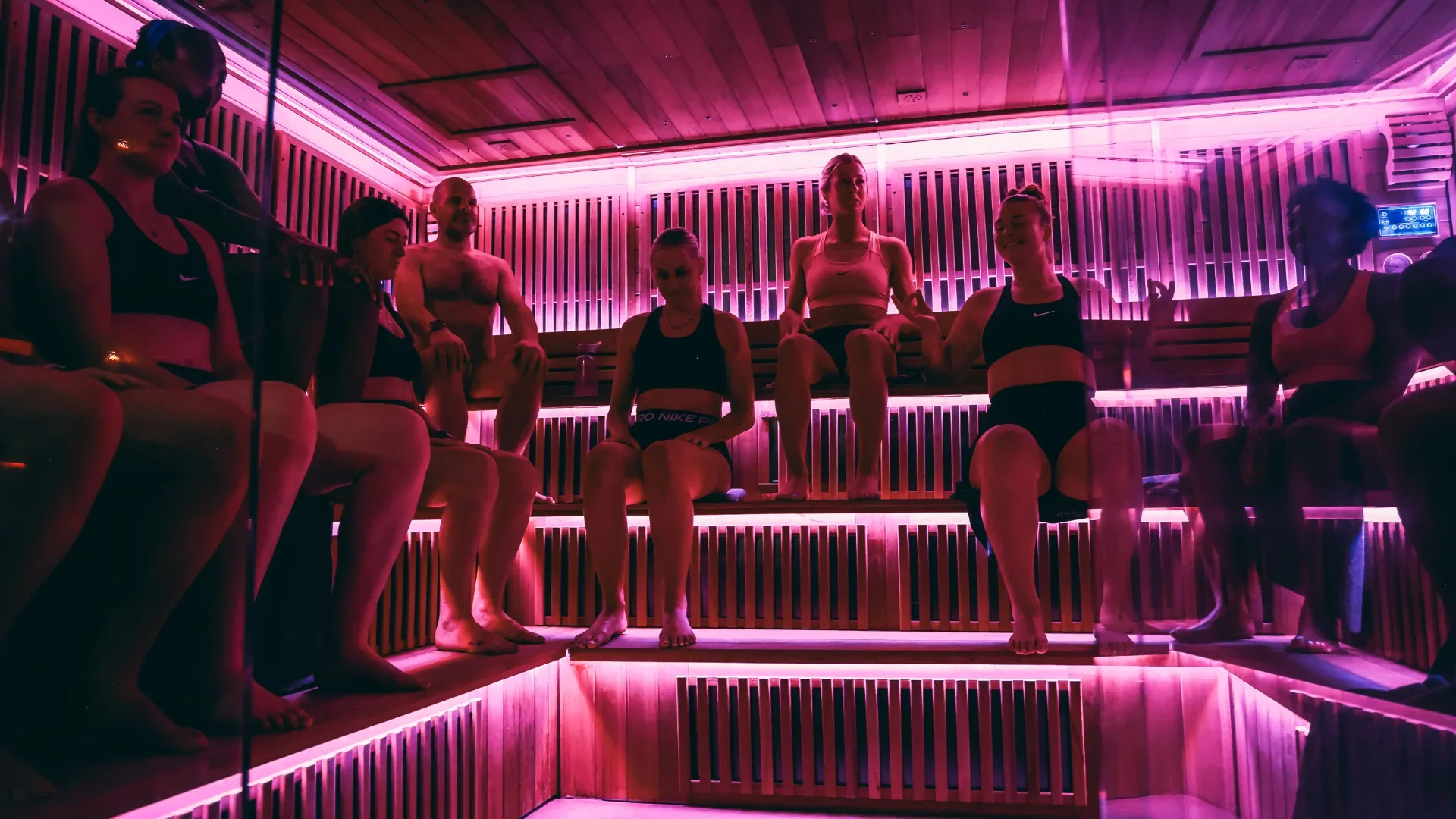
New research from Finland gives us a fascinating glimpse into what heat actually does inside the body, and why the cold plunge that follows might matter more than you think.
There’s a moment in the sauna, somewhere around the twenty-minute mark, when your body stops resisting and starts working with the heat. Your pulse lifts. Your skin flushes. Your breathing settles into something slower and deeper.
Most people describe that moment as relaxation. It turns out it’s closer to mobilisation.
A study published in Temperature, led by researchers at the University of Eastern Finland and the University of Turku, has just shown that a single half-hour sauna session temporarily raised the number of every category of white blood cell circulating in the blood. These are the cells responsible for spotting and responding to pathogens. Participants took a brief cold shower partway through the session.
If you’ve ever finished a Fire & Ice session at Urban Spa feeling like something in you has been switched on rather than switched off, this is part of the explanation.
What the researchers actually measured
Fifty-one adults, average age fifty, took part. Blood was analysed before, during and after the session, tracking both immune cells and cytokines, the chemical messengers immune cells use to coordinate a response.
The headline finding was the surge in white blood cells, including neutrophils and lymphocytes, which drifted back to baseline roughly half an hour after the sauna finished.
That return to normal is not a disappointment. It’s the interesting part.
The researchers’ interpretation is that heat exposure pulls white blood cells out of the tissues where they’re ordinarily parked and pushes them into circulation, where they can sweep the body for threats before being redeposited. A cell sitting in storage can’t patrol, so this periodic release into the bloodstream is considered a good thing.
The same kind of mobilisation happens when you exercise. Which is a rather elegant piece of symmetry: the sauna appears to speak to the immune system in a language it already knows from movement.
The cytokine results were more nuanced. On average, sauna bathing shifted circulating cytokine levels only slightly. But individual responses tracked with how much each person’s core temperature actually climbed, a relationship that didn’t appear for the white blood cell counts.
In other words: how hot you get changes part of the picture, but not all of it.
The honest caveats
We’d rather tell you what a study doesn’t show than oversell what it does.
This experiment captured the immediate aftermath of one sauna session. It can’t tell us whether repeated sauna use produces durable changes in immune function or long-term health outcomes.
A temporary rise in circulating immune cells is not the same as being harder to make ill. Nobody has demonstrated that yet. What this research does offer is a plausible mechanism, a possible thread connecting the acute biology of heat exposure to the broader health associations already observed in regular sauna users.
That’s genuinely useful. It’s just not a headline that says “sauna prevents colds”, and we’re not going to pretend otherwise.
Why the cold matters
Notice that the protocol wasn’t heat alone. There was a cold shower in the middle of it.
That’s not incidental. Contrast therapy, meaning deliberate heat followed by deliberate cold, is a different stimulus to sitting in a hot room for half an hour. The vasoconstriction of the cold, the vasodilation of the heat, the pump between the two: this is why the traditional Finnish practice has always alternated rather than simply endured.
At Urban Spa, our Fire & Ice offering is built around exactly this rhythm. Sauna. Ice bath. Repeat. Rest. It isn’t a novelty and it isn’t a dare. It’s a centuries-old protocol that modern physiology keeps finding new reasons to respect.
How to use this at R1SE
A few practical notes for making your sauna time count:
Give it time. The study used thirty minutes. If you’re in and out in eight, you’re getting the warmth but not much of the physiological signal.
Break it up. Two or three rounds of heat interspersed with cold beats one long, grim endurance test. Aim for around ten to fifteen minutes in the heat, a short cold exposure, then a proper rest before going again.
Rest properly. The recovery phase between rounds is where a lot of the adaptation happens. Sit down. Breathe. Resist the urge to check your phone.
Hydrate before, during and after. You’ll lose more fluid than you expect.
Listen to your body. Dizziness, nausea or a headache means you’re done for the day, not that you need to push harder. If you’re pregnant, managing a cardiovascular condition, or on medication that affects blood pressure or thermoregulation, speak to your GP before starting a contrast routine.
Be consistent. The Finnish evidence base on long-term benefits is built on people who use the sauna several times a week for years, not on anyone’s heroic single session.
The bigger picture
We built the Urban Spa at Kelham Island around a simple conviction: recovery isn’t the soft option that follows the real work. It is real work, just a different kind, with its own physiology and its own returns.
Studies like this one keep confirming what the practice already suggested. Heat is not passive. Cold is not punishment. Sitting still in a hot wooden room, sweating, then plunging into cold water and doing nothing at all for ten minutes, is an active intervention in how your body operates.
Your immune system, it seems, has been paying attention the whole time.
Fire & Ice is available at R1SE Urban Spa, Kelham Island. New to contrast therapy? Speak to the team on arrival and we’ll walk you through a first session properly.
Source: Heinonen, I.H.A. et al. (2026). Acute Finnish sauna heat exposure induces stronger immune cell than cytokine responses. Temperature, 13(2), 186. University of Eastern Finland / University of Turku.
This article is for general information and isn’t medical advice. If you have a health condition, check with a qualified professional before beginning heat or cold exposure.