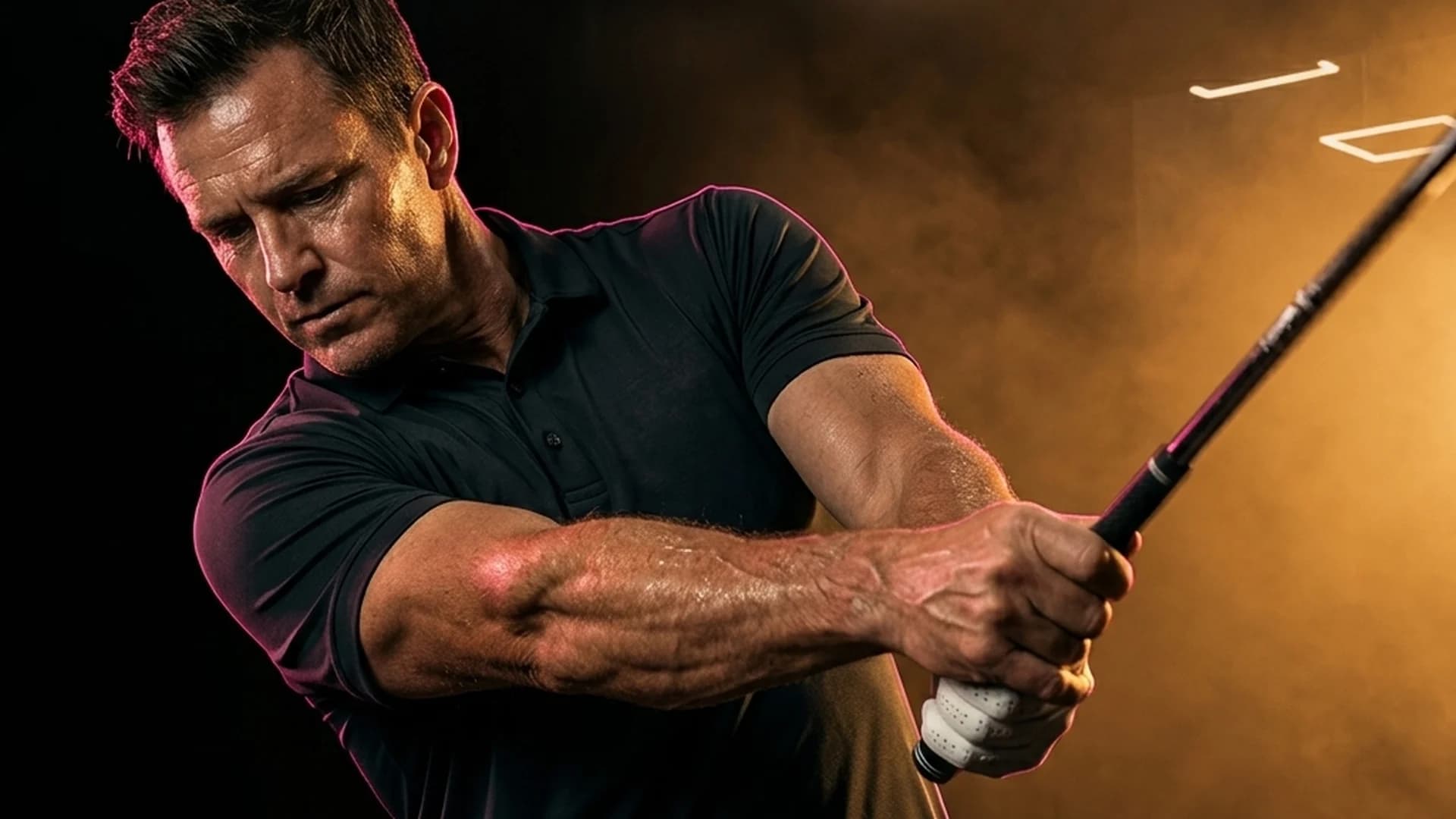
Golf
Unlock your swing.
Your golf swing is only as good as your body allows it to be. Restricted hip rotation, tight thoracic spine, weak core, and poor balance all limit your swing and cause the back, shoulder, and elbow problems that plague golfers. R1SE Sheffield addresses every physical limitation that holds your game back.
The modern golf swing is among the most biomechanically demanding athletic movements in any sport - peak spinal rotation velocities of 300°/second, ground-reaction forces up to 1.5× body weight, and compressive loads on the lumbar spine approaching 8× body weight on a full drive. The physical prerequisites are well established by the Titleist Performance Institute (TPI) and golf-specific sports-medicine literature: hip internal rotation (right hip for a right-handed golfer), thoracic spine rotation, scapular control, rotational core power, and single-leg stability. Restrictions in any of these create the 'compensation cascade' that produces both lost distance and the back pain affecting up to 60% of amateur golfers. The good news: every one of these physical limits is highly modifiable. TPI's work and subsequent research consistently show that golf-specific mobility and strength training improves club-head speed, ball-striking consistency, and - most importantly - reduces the back, elbow and shoulder injuries that end many amateur golfers' seasons. At R1SE we combine Hot Yoga (for hip and thoracic mobility), Reformer Pilates (for rotational core and single-leg control), Red Light (for the tendinopathies golf creates), and Compression (for post-round leg recovery) - the exact interventions TPI's protocols recommend.
Your Multi-Therapy Plan
How R1SE Can Help
The Science
Evidence-based insights supporting our approach.
Hip internal rotation is the single biggest physical predictor of club-head speed in recreational golfers (Gulgin et al., 2015, International Journal of Sports Physical Therapy) - golfers with restricted hip rotation compensate with lumbar spine rotation, directly driving the back pain endemic to the sport.
A 2019 systematic review (Ehlert et al., Sports Biomechanics) confirmed that rotational core strength training improves driving distance by an average of 4-6% in amateur golfers - meaningful yardage gains without technique changes, just better physical preparation.
Yoga-based flexibility programmes improve golf performance scores, swing consistency, and reduce back pain in golfers - with particularly strong effects in the over-50 population where mobility loss is often the limiting factor (Evans et al., 2006, International Journal of Sports Medicine).
Thoracic spine mobility is directly correlated with swing consistency and injury prevention (McHardy & Pollard, 2005, BJSM). The classic amateur golfer's 'reverse C' impact position often stems from thoracic extension restriction - highly modifiable with targeted mobility work.
Up to 60% of amateur golfers experience lower back pain at some point (Gluck et al., 2008, Sports Medicine) - with the predominant mechanism being compensatory lumbar rotation for lost hip or thoracic rotation. Restoring the upstream mobility typically resolves the downstream pain.
The Titleist Performance Institute (TPI) screening and training approach - which centres on mobility, core stability, and rotational power - is now the dominant framework in elite golf fitness. The modalities R1SE offers align closely with TPI's recommended programming.
Common Questions
Loading form...
You May Also Be Interested In
Ready to Start?
Whether you want to book a session, explore our recovery therapies, or speak to someone about a personalised plan - we are here for you.